Best Expression Pedal for Helix: 4 Picks and Setup Tips

4 hours ago
6 min read
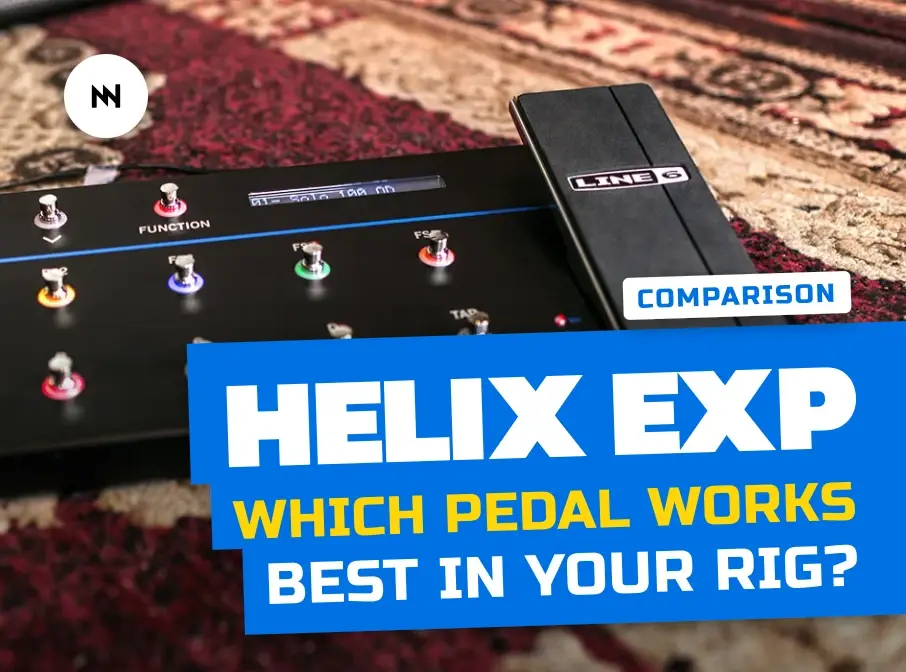
An expression pedal lets you turn a static Helix preset into something you can shape while you play, from a wah sweep to a slow delay change. We compare four options to help you find the best expression pedal for Helix, then show how to assign parameters and check the full heel-to-toe range. Cable wiring and controller sockets vary more than you might expect, so a pedal that looks right on paper can still need careful setup.
Note: This post contains affiliate links. If you choose to buy through them, I'll get a small kickback - at no extra cost to you. It helps me keep Noise Harmony going. Thank you!
Table of contents
Mission Engineering EP1-L6: the best expression pedal for Helix
The Mission Engineering EP1-L6 is the strongest overall choice because Mission designed it for Line 6 equipment and Line 6 lists it as fully compatible with Helix and HX. It uses a 10 kΩ linear potentiometer and connects with an ordinary quarter-inch TS instrument cable. The passive design needs no battery or power supply, so there is nothing extra to add under the pedalboard.
The EP1-L6 measures 9.9 by 4 inches at the base, stands 3.25 inches high and weighs 3.5 lb. Its adjustable rocker tension and substantial weight suit precise wah sweeps and slow changes to delay parameters, although small boards may struggle to find room for it. Line 6 says Helix auto-calibrates expression pedals, so move it through its full travel and check the heel and toe readings rather than looking for a manual calibration page.
Best for: full-size Helix control
Connection: quarter-inch TS cable
Potentiometer: 10 kΩ linear
Power: passive, no battery required
Line 6 EX-1: the simplest official option
The Line6 EX-1 is the straightforward alternative when you want an official Line 6 pedal. It is also explicitly listed as fully compatible with Helix and HX, using a 10 kΩ potentiometer and a standard mono TS guitar cable. It can control volume, wah, delay time, reverb mix, tremolo depth and other parameters that Helix allows you to assign. At the time of writing, it costs €75 at Thomann.
On Helix, hold the knob for the parameter you want to control, choose Learn Controller, and move the pedal. Wah, Pitch Wham and Poly Wham blocks normally use EXP 1, while Volume Pedal and Pan blocks normally use EXP 2, but Controller Assign lets you change those defaults. You can also assign one pedal to delay Mix and Feedback, then set separate Min and Max values so the toe position stays musical rather than sending feedback into orbit. Pedal Position can recall the value per snapshot, per preset or globally.
This is particularly useful with our paid Line 6 Helix Aura Delay presets, where expression can move several delay settings together. Our video Line 6 Helix Delay/Mod Preset Pack - AURA demonstrates those delay and modulation sounds and shows why controlled parameter movement can be more useful than a basic volume sweep.
Best for: simple official-brand setup
Connection: quarter-inch TS cable
Control: assignable Helix parameters
Main limit: one expression output
Noise Harmony demonstrates the Aura delay and modulation presets that benefit from expression-controlled parameter changes.
Also check
BOSS EV-30: the best option for dual control
The Boss EV-30 is the most useful choice when one treadle needs to control two devices. Its two electronically isolated expression outputs help avoid ground-loop noise, and each output has a MIN knob for setting the bottom of its range. EXP 2 also has a polarity switch, while both outputs use quarter-inch TRS connections. The die-cast aluminum pedal measures 80 by 192 mm and weighs 780 g.
Line 6 does not certify the EV-30 as fully compatible, so do not assume its included TRS cable will behave correctly with every Helix or HX chassis. Start with the MIN control fully down, test the full heel-to-toe sweep and use EXP 2 if you need its polarity switch. If the entire sweep runs backward, change the relevant EXP Polarity setting to Inverted in Global Settings instead of reversing every parameter separately. At the time of writing, the pedal costs €111 at Thomann.
BOSS's official BOSS EV-30 Dual Expression Pedal video covers the pedal, which offers a compact chassis, dual outputs and range controls, the main reasons to choose it over a Line 6-specific single-output pedal.
Best for: controlling two devices
Connections: two isolated TRS outputs
Controls: two MIN knobs, EXP 2 polarity
Weight: 780 g
BOSS shows the EV-30's compact construction, dual outputs and range controls.
Dunlop DVP4: the best mini volume and expression pedal

The Dunlop Volume X Mini Pedal DVP4 is the smallest choice and the only model here that also works as a conventional audio volume pedal. Its aluminum body measures 75 by 155 by 65 mm and weighs 580 g, which makes it easier to fit beside a crowded row of switches. In expression mode it uses a 10 kΩ potentiometer, a TRS connection and the AUX jack. The pedal is passive and has adjustable rocker tension.
Before connecting it as an expression pedal, set the internal TUNER/EXP switch to EXP and turn its internal minimum trimmer fully counterclockwise. An internal TIP/RING switch reverses the heel and toe direction if required, but you should still check the complete sweep on the exact Helix or HX model you use. A wrong cable or switch setting can cause an inaccurate range or reversed operation. At the time of writing, it costs €143 at Thomann.
Setting up an external expression pedal on HX Stomp can differ from Helix Floor, so check the connections for your exact model. Check the manual for your Helix or HX model before connecting more than one external controller to a shared socket. Dunlop's official video is titled Dunlop Volume X Pedals.
Best for: compact boards
Modes: audio volume or expression
Expression connection: AUX jack with TRS cable
Setup: internal EXP and TIP/RING switches
Dunlop demonstrates how the Volume X family handles volume and expression duties.
Which expression pedal should you buy for Helix?
Choose the Mission Engineering EP1-L6 when you want the safest full-size choice for the classic Helix and HX range. The EX-1 gives you the same official compatibility and costs €75 at Thomann. The EV-30 makes more sense when one pedal must control two devices. Pick the DVP4 when pedalboard space or conventional volume-pedal use matters most.
Whichever model you choose, match the cable to the pedal and test both endpoints before saving presets. Helix Floor uses external EXP 2 and EXP 3 connections, while the external-controller connections differ across models such as HX Stomp and HX Stomp XL. Those differences are why a setup that works on one Helix chassis should not be treated as proof for every other model.
Choose the Helix-Specific Full-Size Pedal
The EP1-L6 is the safest pick when you want official Helix compatibility, a substantial treadle and simple TS wiring. Check Mission's current price and availability before ordering.
More information
Frequently Asked Questions
What expression pedals are officially compatible with Line 6 Helix?
Line 6 explicitly lists the Line 6 EX-1 and Mission Engineering EP1-L6 as fully compatible with Helix and HX. The BOSS EV-30 and Dunlop DVP4 are configurable third-party choices, but Line 6 does not certify them in the same way.
Does Helix need a TS or TRS expression pedal cable?
It depends on the pedal and the Helix hardware. The EP1-L6 and EX-1 use TS cables, while the EV-30 and DVP4 are designed around TRS expression connections that require careful polarity and range checks.
How do I calibrate an external expression pedal on Helix?
Helix calibrates expression pedals automatically rather than offering a normal manual endpoint routine. Move the pedal fully from heel to toe, check that it reaches both endpoints, then inspect the cable, MIN controls, polarity and internal switches if it does not.
Can one Helix expression pedal control several delay parameters?
Yes. Assign the same EXP controller to Mix, Feedback, Time or other supported parameters, then give each assignment its own Min and Max values. This lets one movement create a controlled delay morph without pushing every parameter across its entire range.
FOLLOW US ON


Comments