Best Analog and Hybrid Synths Under €1,000: 7 Picks for 2026

2 hours ago
16 min read
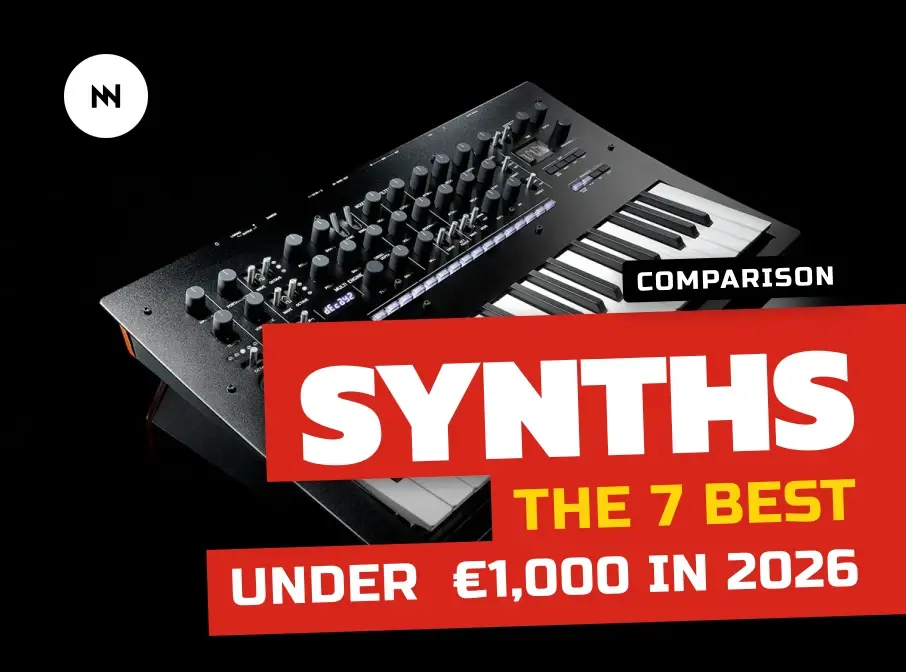
The Korg minilogue xd tops our list of the best analog and hybrid synths under €1,000 because it combines an approachable analog signal path with a digital oscillator, useful effects, preset memory and a proper polyphonic sequencer. The Behringer DEEPMIND 12 gives you more voices for pads, while the Bass Station II and MiniBrute 2 are stronger choices for focused mono sounds. This guide compares seven current analog and hybrid synths using prices, specifications and availability checked at Thomann on November 10, 2026.
Note: This post contains affiliate links. If you choose to buy through them, I'll get a small kickback - at no extra cost to you. It helps me keep Noise Harmony going. Thank you!
Table of contents
The best analog and hybrid synths under €1,000 at a glance

The Korg minilogue xd is the best overall choice for most musicians because it covers chords, sequences, basses and leads without becoming difficult to learn. The Behringer DEEPMIND 12 is the better pick when large chords and longer releases matter more than immediate panel control. For monophonic bass and lead work, the Novation Bass Station II offers the most useful mix of presets, aftertouch and modern firmware features.
The prices in this guide were shown by Thomann on November 10, 2026. Prices and availability can change, so check the final amount and delivery estimate before ordering. Availability ranged from products in stock to waits of four or five weeks.
Korg minilogue xd: best overall
Behringer DEEPMIND 12: best for analog voice count
Arturia MiniFreak 49: best current hybrid
Dreadbox Nymphes: best compact analog poly
Behringer POLY D: best vintage-style paraphonic choice
Novation Bass Station II: best mono bass and lead synth
Arturia MiniBrute 2: best for semi-modular work
What do analog, hybrid, mono, para and poly mean?

A true polyphonic synth gives each played note its own complete voice, usually including an oscillator, filter, amplifier and envelopes. Four voices let you hold a four-note chord, although a long release can steal a voice when you play the next chord. Six or twelve voices leave more room for pads, overlapping notes and sustained playing.
A monophonic synth plays one note at a time, which suits basses, leads and step sequences. A paraphonic synth can pitch separate oscillators from different notes, but those oscillators still pass through shared filters, amplifiers or envelopes. On a POLY D, the four oscillators share one ladder filter rather than using a separate filter for each note.
A hybrid synth combines analog and digital parts. The minilogue xd uses analog VCOs and filtering alongside its digital MULTI ENGINE and effects, while the MiniFreak 49 places digital sound engines before analog filters and VCAs. Digital control, preset storage or digital effects do not automatically make the main audio path digital.
Korg minilogue xd: the best overall analog synth under €1,000

The Korg minilogue xd is the most balanced instrument here for someone buying one synth to cover several jobs. Each of its four voices has two analog VCOs, while the digital MULTI ENGINE adds noise, VPM synthesis and loadable User oscillators. The two-pole analog filter, Drive control and three effect sections take it well beyond a basic four-voice polysynth.
The 16-step sequencer records polyphonic notes and motion for as many as four parameters. You also get POLY, UNISON, CHORD and ARP/LATCH voice modes, 500 program locations with 200 factory presets and 300 user slots for extra sounds such as our 46-preset Fragments pack, and stereo outputs. Its 37 slim keys respond to velocity but lack aftertouch, so players who want full-size keys should look at the DEEPMIND 12 or MiniFreak 49, while the DEEPMIND 12 also adds keyboard aftertouch.
Programming is direct enough for a first hardware instrument. Balance VCO 1, VCO 2 and MULTI in the MIXER, set CUTOFF, RESONANCE, DRIVE and KEYTRACK, then shape AMP EG and the second EG before recording a sequence. Our article on whether the minilogue xd suits beginners explains that starting point, while the Isenveil ambient pack covers ready-made pads and evolving sounds.
At the time of writing, it was €569 at Thomann and shown in stock. Buy it if you want chords, motion sequencing, effects and preset recall in one manageable instrument. Skip it if four voices or the slim keyboard will restrict the way you play. Our KORG Minilogue XD FRAGMENTS full sound demo runs through all 46 presets and shows how the synth handles dark pop and electronic sounds.
Four-voice analog and digital hybrid
Two analog VCOs plus MULTI ENGINE per voice
16-step polyphonic sequencer with four motion lanes
500 programs: 200 factory presets and 300 user slots
37 velocity-sensitive slim keys
Stereo outputs, USB-B, MIDI, Sync and two CV inputs
Our FRAGMENTS demo plays all 46 Minilogue XD presets across dark pop and electronic styles.
Behringer DEEPMIND 12: the best choice for voice count

The Behringer DEEPMIND 12 is the clear choice when twelve complete analog voices matter more than an onboard note sequencer. Each voice has two oscillators, two LFOs and three ADSR envelopes for the amplifier, filter and modulation. Its low-pass filter switches between two-pole and four-pole modes, followed by a common 6 dB-per-octave high-pass filter.
Twelve voices give sustained chords and pads more room than the four-voice minilogue xd. An eight-slot modulation matrix connects 22 sources to 130 destinations, and each program can load four effects. The instrument stores 1,024 programs, has a 49-key semi-weighted keyboard with velocity and aftertouch, and includes remote editing over USB, MIDI or built-in Wi-Fi.
Its 32-step section is a control sequencer, not a normal melody sequencer. It can move pitch, filter and effect parameters while you hold a chord, but it does not replace the note sequencer found on the Korg. The panel also has many controls, while the LCD displays the MOD MATRIX and FX pages.
At the time of writing, it was €629 at Thomann and shown in stock. Buy it for large pads, full-size keys, aftertouch and dependable preset recall on stage. Skip it if you want quick melody sequencing or almost every function on a dedicated knob. Behringer's DEEPMIND 12 Filter video demonstrates the filter controls and how they shape a patch.
12 analog voices
Two oscillators, two LFOs and three envelopes per voice
Two-pole or four-pole low-pass filter
32-step control sequencer
1,024 program memories
49 semi-weighted keys with velocity and aftertouch
Why it is different from the minilogue xd
The DEEPMIND 12 is better for six-note chords, long releases and layered playing because it has three times the voice count. The minilogue xd is easier to recommend for compact setups that need a polyphonic note sequencer, digital oscillators and two CV inputs. Both store patches and include effects, so this choice mainly comes down to voice count, keyboard size and sequencing.
Current software
Behringer lists firmware v1.1.2 as the current release. Its official download area also provides the DeepMind 12 App and USB audio driver v1.0.7. Behringer does not expose the complete v1.1.2 change list as readable page text, so no undocumented fixes are assumed here.
Behringer demonstrates how the DEEPMIND 12 filter shapes its analog voices.
Arturia MiniFreak 49: the best current hybrid

The Arturia MiniFreak 49 is the newest synth in this list and the furthest from a traditional analog design. Introduced in October 2026, it has two digital engines with more than 30 oscillator modes and six-voice polyphony. Each voice then passes through its own analog state-variable filter and analog VCA.
The engines cover virtual analog, wavetable, sample and granular, FM, ring modulation and digital processing. Engine 2 can process Engine 1, while the analog filter offers low-pass, band-pass and high-pass modes, self-oscillation and bipolar audio-rate Filter FM. Three effect slots each provide 13 algorithms, giving the instrument more onboard processing range than the purely analog mono synths below.
This model adds 49 full-size semi-weighted keys with velocity and mono aftertouch, proper aluminum pitch and modulation wheels, separate controls for both engines and a larger OLED compared with the original MiniFreak. The pressure-sensitive XYZ matrix handles modulation routing, preset browsing and Freak Control gestures. Its 64-step sequencer records four modulation lanes, and MiniFreak V software is included.
At the time of writing, it was €789 at Thomann, with stock expected in about one week. Buy it if you want wide oscillator choice, full-size keys, deep modulation and strong DAW links. Skip it if your priority is an analog oscillator signal path or you need a synth immediately.
Six-voice digital and analog hybrid
Two digital engines with more than 30 modes
Analog multimode filter and VCA per voice
64-step sequencer with four modulation lanes
49 semi-weighted full-size keys with velocity and mono aftertouch
USB-C, MIDI In/Out/Thru, clock connections and audio input
Preset memory and firmware notes
The MiniFreak 49 provides 350 factory presets and 162 user locations. The current firmware shown by Arturia is version 1.1.5, dated October 19, 2026. MiniFreak V 5.1.1.6945 is the companion software version listed on the download page.
How the modulation matrix works
Touch a source and destination intersection on the XYZ matrix, then turn the Matrix encoder to set positive or negative depth. The capacitive step controls and the matrix's Curve and Amplitude axes can draw a custom LFO. In Seq mode, four pages of 16 steps provide the full 64-step pattern.
Dreadbox Nymphes: the best compact analog poly

The Dreadbox Nymphes puts six analog voices in a small desktop module. Each voice has one VCO, a sub-oscillator, a 24 dB resonant low-pass filter, two ADSR envelopes and one LFO. Its synthesis signal path is analog, with digital reverb added as an effect.
Nymphes provides 98 memories, divided between 49 factory and 49 user presets, but it has no keyboard or sequencer. Its compact panel also reuses controls through SHIFT functions, with Catch and Jump fader modes available. You should include the price of a controller or sequencer if you do not already own one. Our comparison of the best MIDI keyboards for small home studios covers keys, pads, DAW control, desk space, price and connections.
Firmware V2 added MPE, polyphonic aftertouch, polyphonic modulation targets, preset import and export, MIDI Channel Learn and replaceable factory presets. Those changes make the module much more expressive when paired with a suitable controller. The connection list remains simple, with USB MIDI, a supplied DIN-to-3.5 mm MIDI adapter, mono output and a separate headphone output.
At the time of writing, it was €458 at Thomann and shown in stock. Buy it if you already have a controller and want six analog voices in little desk space. Skip it if you need a self-contained keyboard, built-in sequencing or stereo main outputs. Dreadbox's official Nymphes demonstration lets you hear the six-voice engine and compact control system in use.
Six analog voices
One VCO and sub-oscillator per voice
24 dB low-pass and 6 dB high-pass filters
98 memories: 49 factory and 49 user
MPE and polyphonic aftertouch support with V2 firmware
USB powered desktop module with no sequencer
Dreadbox demonstrates the Nymphes six-voice engine and its compact controls.
Also check
Behringer POLY D: the best vintage-style paraphonic option

The Behringer POLY D is a well-executed take on the famous Minimoog Model D design, expanded with four analog VCOs, a ladder filter, distortion and analog BBD stereo chorus. Its oscillators span six overlapping ranges and can mix triangle, saw-derived, square and pulse waveforms with white or pink noise. An external input can also enter the mixer.
Behringer calls it a four-voice polyphonic synth, but it does not behave like four complete minilogue xd voices. The oscillators share one ladder filter, so its Poly mode is better understood as paraphonic-style chord playing. You can pitch four oscillators from separate notes, but you do not get four independent filters and envelopes.
The 32-step sequencer stores eight patterns in each of eight banks and supports ratchets, accents and swing. It also has a separate arpeggiator, 37 full-size semi-weighted keys and extensive MIDI, USB, Sync and CV connections. There is no patch memory, so returning to an exact sound means noting the panel settings or taking a photo.
At the time of writing, it was €499 at Thomann, with an estimated four-to-five-week restock window. Buy it for hands-on basses, leads, sequences and vintage-style oscillator stacks. Skip it if you need independent polyphonic articulation or instant patch recall during a set. Behringer's Introducing the POLY D shows its oscillator, filter, chorus and sequencing sections.
Four analog VCOs with a shared ladder filter
Mono, Unison and four-note Poly modes
Switchable low-pass or high-pass ladder filter
32-step sequencer with eight banks of eight patterns
37 full-size semi-weighted keys
No sound preset memory
A basic POLY D sequence
The 32-step sequencer supports rests, gate length changes and ratchets.
Allow time for tuning
Analog oscillators can drift in pitch while their circuits settle after power-up. Allow the POLY D time to reach a stable operating temperature before checking its tuning. This gives its analog circuits time to settle.
Behringer introduces the POLY D oscillator, filter, chorus and sequencing sections.
Novation Bass Station II: the best mono bass and lead synth

The Novation Bass Station II is the strongest focused mono synth here for basses, leads and sequenced lines. It has two digitally controlled analog oscillators, a sub-oscillator, ring modulation and an analog signal path. The Classic multimode filter covers low-pass, band-pass and high-pass responses, while the separate Acid filter concentrates on low-pass sounds.
Its 25-note keyboard supports velocity and aftertouch, and 128 memories make it more practical on stage than a mono synth without patch storage. The arpeggiator and step sequencer handle patterns up to 32 notes, with four sequence memories. USB, five-pin MIDI, external audio input and USB or adapter power make it easy to move between a studio and a compact live setup.
Paraphonic mode splits the two main oscillators between two notes, but they still share the filter and amplifier. Hold Function and double-tap Osc 1-2 Sync, then change P-0 to P-1 with Patch/Value to enable it. Firmware 4.14 also adds AFX Mode, which places a separate parameter overlay on every key across eight banks of 25 overlays.
At the time of writing, it was €399 at Thomann and shown in stock. Buy it if you want stored bass and lead sounds, aftertouch, AFX Mode and a self-contained sequencer. Skip it if chords and pads are central to your music. Novation's Bass Station II overview covers the oscillator, filter, modulation and performance controls.
Monophonic with two-note Paraphonic mode
Two DCOs, sub-oscillator and ring modulation
Classic multimode and Acid low-pass filters
128 patch memories
Four sequencer memories of up to 32 notes
25 velocity-sensitive keys with aftertouch
Firmware still matters
Firmware 2.5 added filter tracking, Paraphonic mode and microtuning. Version 4.14 later added AFX Mode, fixed-duration envelopes, wider sub-oscillator tuning, oscillator glide divergence and adjustable envelope-retrigger count. Novation Components manages firmware, patches, overlays and tuning tables.
Novation walks through the Bass Station II oscillator, filter and performance controls.
Arturia MiniBrute 2: the best semi-modular monosynth

The Arturia MiniBrute 2 is the best choice here for learning semi-modular routing and connecting to Eurorack gear. It is a monophonic analog synth with two VCOs, a 48-point CV/Gate patchbay and a Steiner-Parker filter. The signal path is pre-patched, so it makes sound without inserting a single cable.
VCO 1 mixes saw with UltraSaw, square with pulse-width control and triangle with Metalizer. VCO 2 supplies sine, saw and square waves, while hard sync and linear or exponential FM connect the two oscillators. The 12 dB filter offers low-pass, high-pass, band-pass and notch modes and can self-oscillate.
The sequencer stores eight patterns of up to 64 steps, and the arpeggiator provides eight playback directions. Its 25-note keyboard responds to velocity and aftertouch, while MIDI, USB and the patchbay cover conventional and modular control. Like the POLY D, it has no patch memory, so it is less convenient when a live set needs several exact sounds.
At the time of writing, the black MiniBrute 2 Noir was €429 at Thomann and shown in stock. Buy it if you want a hands-on mono synth that can grow into a modular setup. Skip it if you need saved sounds, polyphony or onboard effects.
Monophonic analog signal path
Two VCOs plus noise and external audio
12 dB Steiner-Parker multimode filter
48-point CV/Gate patchbay
Eight sequences of up to 64 steps
25 velocity-sensitive keys with aftertouch
Your first patch-cable experiment
Start without cables by balancing VCO 1, VCO 2, Noise and External in the oscillator mixer. Set the filter and Brute Factor, then shape the sound with the ADSR and AD envelopes. Once that works, patch an LFO to VCO 1 FM or send the AD envelope through the attenuator to modulate its own Decay.
Current software
Arturia lists MiniBrute 2 firmware 1.0.18.73, dated February 21, 2018. The current MIDI Control Center entry is version 1.23.0.134, dated June 10, 2026. No later MiniBrute 2 firmware is shown on the official download page.
Which of these seven synths should you buy?

Choose the minilogue xd if this is your first analog or hybrid hardware synth and you want the fewest major gaps. It handles four-note chords, mono-style unison sounds, effects and programmed patterns while storing every complete sound. Our Minilogue versus Minilogue XD comparison explains where the XD model adds value over the older design.
Choose the DEEPMIND 12 for pads, sustained chords and live sets that need full-size keys, aftertouch and lots of preset storage. The MiniFreak 49 also suits stage and studio players, but its digital engines offer a wider range of synthesis methods rather than a traditional two-oscillator analog structure. Nymphes gives you six analog voices for less money, provided you already have a controller and sequencer.
For basses and leads, the Bass Station II is the safest all-round mono choice because it stores patches and includes aftertouch. The POLY D gives you four oscillators, chorus and vintage-style hands-on control, but no sound memory. MiniBrute 2 makes the most sense when its patchbay and modular connections are part of the reason you are buying it.
What else do you need to connect and record a hardware synth?

You need an audio connection because USB MIDI does not usually carry the synth's sound. Run a mono output into one line input on your audio interface, or connect both left and right outputs when the synth and its effects produce stereo sound. The minilogue xd and DEEPMIND 12 have stereo outputs, while Nymphes and Bass Station II use mono main outputs.
USB or five-pin MIDI lets your DAW record notes and send them back to the synth. MIDI clock can keep an onboard sequencer or arpeggiator aligned with a project, while analog Sync and CV/Gate are useful when other hardware uses those standards. Our tutorial on connecting a hardware synth to a DAW explains the audio, MIDI, clock and monitoring steps in order.
A basic setup needs the correct audio cable, headphones or monitors, and an interface if your computer has no suitable line input. Nymphes also needs an external MIDI controller or sequencer, and USB power must supply at least 1,000 mA. Semi-modular work with the MiniBrute 2 may require extra 3.5 mm patch cables, depending on what you want to connect.
Limits to keep in mind before buying

None of these synths covers every job. Four minilogue xd voices can run out during long pad releases, the DEEPMIND 12 trades immediate simplicity for deeper menus, and the MiniFreak 49 does not use analog oscillators. Nymphes needs extra control hardware, while POLY D and MiniBrute 2 cannot recall complete sounds.
Keyboard differences also matter more than a spec sheet suggests. The minilogue xd has 37 slim keys without aftertouch, Bass Station II and MiniBrute 2 have 25 keys with aftertouch, and DEEPMIND 12 and MiniFreak 49 provide larger 49-key keyboards. The MiniFreak 49 uses mono aftertouch, so pressure affects the whole keyboard rather than each note separately. If you play with both hands, the larger instruments are easier to use without an external controller.
The Korg minilogue xd is the best all-round choice
The minilogue xd gives a first-time buyer the best balance of analog control, digital range, preset storage, effects and useful sequencing. Four voices are a clear limit, but they still cover ordinary chords, basses, leads and compact pads. Its user oscillator and effect slots also leave room for new sounds after you understand the basic signal path.
Choose something else when one need clearly outweighs that balance. The DEEPMIND 12 is better for large pads, the Bass Station II is better for focused mono work, and the MiniBrute 2 is better for CV patching. Buying the instrument that fits your real workflow is more useful than buying the one with the longest feature list.
Add Ready-Made Sounds to Your minilogue xd
Fragments adds 46 dark pop and electronic presets made for the Korg minilogue xd. Each sound is ready to play and gives you a practical starting point for your own edits.
More information
Frequently Asked Questions
What is the best analog or hybrid synth under €1,000?
The Korg minilogue xd is the best overall choice for most buyers. It combines four analog voices, a digital MULTI ENGINE, effects, 500 program locations including 200 factory presets and a polyphonic sequencer. It was €569 at Thomann on November 10, 2026.
What is the best polyphonic analog synth under €1,000?
The Behringer DEEPMIND 12 is the best choice when voice count is the priority. Its twelve analog voices handle larger chords and overlapping pad releases more comfortably than four- or six-voice instruments.
What is the best analog synth for a beginner?
The Korg minilogue xd is the easiest all-round recommendation because it combines direct controls. The Bass Station II is also approachable if you mainly want basses and leads.
Should I buy a monophonic or polyphonic synth?
Buy a polyphonic synth if you want to play chords and pads directly from the keyboard. Choose a monophonic synth for focused bass, lead and sequence work, especially when detailed control matters more than chords.
Is the Behringer POLY D truly polyphonic?
Not in the same way as a minilogue xd or DEEPMIND 12. Its four oscillators can receive separate pitches in Poly mode, but they share one ladder filter, so its behavior is closer to paraphony.
Korg minilogue xd or Behringer DEEPMIND 12?
Choose the minilogue xd for easier sequencing, digital oscillator options, CV inputs and a smaller instrument. Choose the DEEPMIND 12 for twelve voices, full-size keys, aftertouch and larger sustained chords.
How many voices do I need for chords and pads?
Four voices cover basic four-note chords, but notes can be stolen when long releases overlap. Six voices give more room, while twelve voices are much safer for wide chords and sustained pads.
Do I need an audio interface to record a hardware synth?
Usually, yes. USB on these instruments mainly handles MIDI, so an audio interface records their mono or stereo line outputs and lets you monitor them without relying on a computer's microphone input.
FOLLOW US ON


Comments