GTA Main Themes Compared: From the Original 1997 Game to GTA VI

54 minutes ago
10 min read
I have followed GTA for years, and hearing these opening themes again on the eve of GTA VI feels like opening a box of old saves. The GTA main theme has moved through 1990s rap, laid-back jazzy grooves, synth-pop, West Coast hip-hop and dark orchestral scoring across almost three decades. Ahead of GTA VI’s release on November 19, 2026, I’m comparing the title and menu themes of the main games in the series, in release order, including the early ones that did not have one neat instrumental motif. Spin-offs like London 1969, Liberty City Stories, Vice City Stories and Chinatown Wars stay out of this one.

Table of contents
GTA (1997): the series starts with a rap track

The first GTA uses a vocal hip-hop track rather than the short instrumental theme later games would favor. Da Shootaz’s “Grand Theft Auto,” better known among fans as “Joyride,” is a rough rap record with a booming, bassy beat and a vocal delivery modeled on Chuck D of Public Enemy. It has the sound of a rough mid-1990s crime record, which fits the small top-down cities better than a polished film score would have done.
Da Shootaz was one of the game’s fictional acts, alongside Slumpussy and CCC. DMA Design musician Craig Conner wrote the beats and skeleton lyrics, and Robert De Negro (real name Jonathan Wilson) rapped them. In an interview I came across, he told Time Extension that Conner wanted the track “booming and bassy.” The game’s credits list Craig Conner, Colin Anderson and Grant Middleton under music written, produced and performed by, with De Negro among the additional musicians, and Allan Walker, Raymond Usher, Anderson, Conner and Middleton on sound effects. One thing that confused me at first: fans call the track “Joyride,” but its official title is simply “Grand Theft Auto.”
While digging through old interviews, I found a nice hardware detail. In a 2005 interview with Sound On Sound, Craig Conner and Allan Walker said the Manhunt soundtrack was made almost entirely on an old Korg Mono/Poly, run through distortion and lo-fi effects. Nothing links that synth to the original GTA theme, but as a synth guy I love details like this: they show how Conner approached electronic sound.
GTA 1 (GTA I) - Main Theme | Da Shootaz - "Joyride"
GTA 2: a laid-back, jazzy menu
GTA 2’s menu plays “Short Change” by E-Z Rollers. The duo came from the drum and bass scene, but this track is nothing like a fast d&b workout: it’s laid-back and jazzy, with a relaxed groove that lets you sit in the menu for a while. It’s a cool, almost lounge-like contrast to the rough rap of the first GTA.
The credits list “Short Change” to A. Banks and J. Hurren, better known as E-Z Rollers members Alex Banks and Jay Hurren, and names Moving Shadow under additional music. GTA 2’s internal audio manager was Colin Anderson, with Raymond Usher, Adrian Hirst and Paul Scargill on audio programming. Allan Walker and Anderson handled sound effects, while Craig Conner, Stuart Ross, Scargill, Anderson and Bert Reid supplied other music. In other words, the menu cue came from outside the main DMA music group, while much of the game’s audio remained an in-house job.
GTA 2 (GTA II) - Main Theme | E-Z Rollers - "Short Change"
GTA III: a quiet theme for a gray Liberty City
GTA III replaces the vocal tracks of the early games with a slow instrumental built on a piano part that runs from the very first bar to the last. Around it sit a dusty hip-hop groove, restrained strings, a deep bass line and dry drums. It sounds calm but uneasy, as if Liberty City is waking up before something goes wrong, and that mood fits the game’s rain, concrete and muted colors.
When I went through the credits, I found the score listed under Craig Conner and Stuart Ross, but they don’t say which of the two wrote the main theme. Allan Walker handled sound design and mastering, Raymond Usher worked on audio programming, and Terry Donovan was the music supervisor. Dan Houser directed the cutscene audio, while Conner, Ross, Walker and Lazlow also worked across the radio production. The honest credit is therefore Conner and Ross together, because a more specific authorship claim is not supported by the game’s published credits.
Grand Theft Auto III (GTA 3) - Main Theme
Vice City: synths turn the title screen into 1980s television
“Theme from Vice City” sounds like a lost 1980s crime-show title cue. Bright synth chords, a melodic analog-style lead and electronic drums with fills that recall gated toms carry it. The music is glossy and warm, but a darker chord movement sits underneath it, which catches both the neon postcards and the criminal story behind them.
The track is credited to Lex Horton, then an in-house Rockstar musician. What surprised me is that its only official release was the *Grand Theft Auto: Vice City O.S.T. - Greatest Hits* CD rather than the big soundtrack box set. Vice City’s broader audio team included Allan Walker, Craig Conner, Raymond Usher, Stuart Ross and Will Morton, with Terry Donovan as soundtrack coordinator and Heinz Henn providing music consultancy. One useful detail is that the theme creates the period without borrowing a famous hit, even though licensed 1980s songs dominate the car radio once the game begins.
Grand Theft Auto: Vice City - Main Theme
San Andreas: G-funk defines the West Coast setting
The San Andreas theme brings the series into early-1990s West Coast hip-hop. It rides on a drum-machine beat, heavy synth bass, clipped guitar or clavinet-like figures and high synth lines that carry a clear G-funk flavor. It sounds confident and threatening at the same time, matching Los Santos before the map opens into the countryside, San Fierro and Las Venturas.
Michael Hunter wrote and produced the theme music. The game’s credits list the rest of the audio team: Allan Walker as lead audio designer, Craig Conner as lead music producer, and Jon McCavish and Will Morton as audio designers. Tim Sweeney and Heinz Henn supervised the soundtrack, while Dan Houser and Navid Khonsari directed the audio. Hunter would later write GTA IV’s theme, but the two pieces sound so different that the shared composer is easy to miss.
Grand Theft Auto: San Andreas (Official Theme Song)
Also check
GTA IV: Soviet Connection makes the theme cinematic
GTA IV’s “Soviet Connection” combines Eastern European colors with a modern crime score. It moves with a heavy, driving pulse, with cimbalom-like plucked notes, accordion colors, strings, low brass and hard electronic percussion. The result is cold and restless, fitting Niko Bellic’s arrival in a Liberty City that promises more than it gives.
The credits name Michael Hunter as writer and producer of the theme music, and “Soviet Connection (The Theme from Grand Theft Auto IV)” opens and closes the end credits. Craig Conner was music producer, while Matthew Smith and Allan Walker held the lead audio roles. Will Morton, Jon McCavish and George Williamson were the credited audio designers. Hunter had also written the San Andreas theme, making this a good example of one composer changing his musical language to match a different protagonist, city and decade.
Soviet Connection (Theme from GTA IV)
GTA V: Welcome to Los Santos returns to funk and hip-hop
GTA V’s recognized main theme is “Welcome to Los Santos” by Oh No, although the game also uses ambient score beds around its loading and menu screens. It mixes West Coast hip-hop with funk bass, dry drums, guitar or clavinet-like chops and bright synth lines. It sounds sunny, expensive and slightly crooked, which is a good musical summary of Los Santos and its three protagonists.
Oh No composed the theme, while the wider reactive score was created by Tangerine Dream, Woody Jackson, The Alchemist and Oh No. GTA V’s credits name Craig Conner as music director and Matthew Smith as audio director. George Williamson and Jon McCavish are listed as sound designers, with Rebecca Johnson and Fraser Morgan working as interactive music developers. That last role matters because GTA V did more than play a fixed theme: its mission score could change with the action.
Tangerine Dream’s work belongs to that wider score rather than the authorship of “Welcome to Los Santos,” but it is a large part of GTA V’s electronic identity. Rockstar combined their material with music from Woody Jackson, The Alchemist and Oh No. My favorite find while researching this piece was an interview with Sound On Sound, in which Thorsten Quaeschning explained that he and Edgar Froese wrote “Los Santos City Map” for the game’s map screen. Inside a game everything loops after about six minutes, he said, so the melody had to work without being busy. That is a very different job from writing a three-minute track that the player hears once.
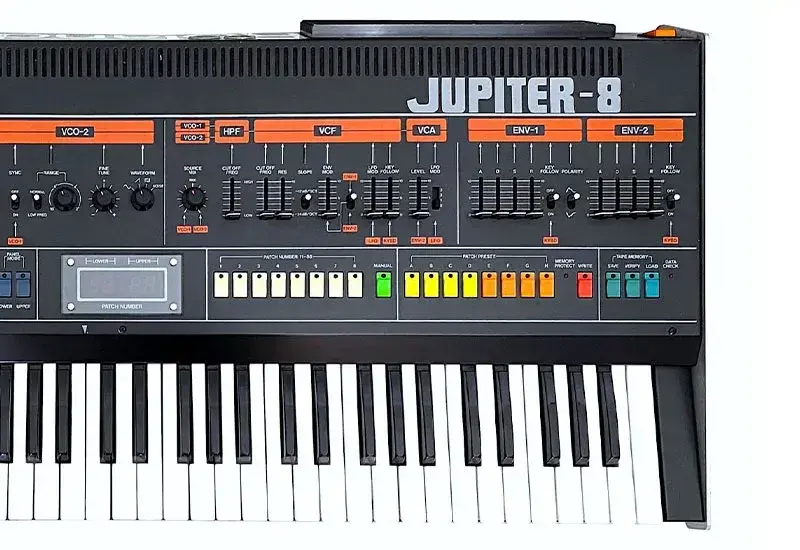
The gear behind “Los Santos City Map” is a small history of electronic music on its own. According to Quaeschning, he used a Roland Jupiter-8, two Moog Voyagers, a Moog Minitaur, Korg Radias, Access Virus TI, Yamaha TG77 and TX802, Korg Wavestation EX and the VirSyn Cube plugin. He then layered the main melody from Roland JD-800 and Mellotron sounds. This list applies to that map cue, not to “Welcome to Los Santos,” but it shows how much analog, digital and software synthesis could sit inside GTA V’s wider score.
Welcome To Los Santos
GTA VI: an electronic theme with no named composer yet
The GTA VI main theme uses a steady electronic pulse rather than the strong melodic hook heard in Vice City, San Andreas or GTA IV. Wide synth pads, a repeating sequenced figure, low electronic bass and tightly processed percussion do the work. The cue feels bright enough for Leonida’s sun and neon, but there is tension under it, as if the music already knows Jason and Lucia’s day by the water will not stay peaceful for long.
Rockstar debuted the cue in the 33-second cover art teaser it posted on June 18, 2026, and fans and several outlets have treated it as the game’s main theme ever since. Rockstar has not named its composer, so we won’t guess. What is confirmed by Rockstar is that Justice, the French duo of Gaspard Augé and Xavier de Rosnay, composed GTA VI’s adaptive original score, and their single “Flower in a Hurricane,” featuring Tame Impala, SZA and King Gizzard & The Lizard Wizard, arrived with the launch trailer on October 15. Grand Theft Auto VI: Original Score by Justice, with 30 tracks plus digital bonus tracks, is due on December 11. Below is Rockstar’s own 33-second cover art reveal, where the theme was first heard.
Honestly, I can’t wait to hear the whole soundtrack. I want to drive around Vice City and listen to my favorite songs on the radio, just like I did in the previous games, and see how this theme feels once it’s playing in the menu instead of a teaser.
Rockstar Games: Grand Theft Auto VI, Official Cover Art Reveal, where the theme was first heard.
Why GTA Themes Sound Like Their Cities
When I played all the themes back to back, one thing jumped out: the music follows the city more than the year. Each place in the series has its own sound, and a game that goes back to an old city goes back to that sound too, just updated for its time.
Liberty City (GTA III, GTA IV): Rockstar’s take on New York gets the coldest music in the series. GTA III’s slow hip-hop groove and lonely piano feel like rain on concrete, and “Soviet Connection” adds dark strings and Eastern European colors for Niko’s story.
Vice City (Vice City, GTA VI): the Miami-style city always gets synths. Lex Horton’s theme sounds like an 80s cop show, and GTA VI keeps the synths but swaps the big hook for a modern electronic pulse.
Los Santos (San Andreas, GTA V): the Los Angeles-style city is hip-hop territory. San Andreas leans on early-90s G-funk, and “Welcome to Los Santos” brings funk and West Coast hip-hop into the 2010s.
Leonida (GTA VI): Rockstar’s take on Florida, with Vice City at its center. The theme feels bright but tense, which fits a state of beaches, swamps and neon where the sunny mood never feels fully safe.
How did the GTA main theme change across the series?
The GTA main theme gradually changed from a track chosen for a menu into a musical summary of the whole game. GTA and GTA 2 borrowed the language of contemporary club and rap records, while GTA III established the short instrumental motif. Vice City, San Andreas and GTA IV then made each city recognizable through synth-pop, G-funk and Eastern European orchestral colors. As the city comparison shows, a GTA theme is less about the decade and more about the streets you’re about to drive down: same city, similar musical DNA, even 10 or 20 years apart.
GTA V blurred the line between a title theme and a wider reactive score, while GTA VI hands the whole score to Justice. Its teaser theme leans less on a singable melody than the older favorites and more on a pulse, layered synths and atmosphere to introduce modern Vice City.
I have been a fan of the series for years, and like everyone else, I have waited a long time for this release. That is why today’s article became a slightly nostalgic trip through the music that introduced each GTA world before we even started playing. Will you be playing GTA VI at launch, and which main theme is your favorite? Let us know in the comments!
See GTA VI Before Launch
Rockstar’s official GTA VI page has the confirmed release details and current game information. The game arrives on PlayStation 5 and Xbox Series X|S on November 19, 2026.
More information
Frequently Asked Questions
Who composed the GTA San Andreas theme?
Michael Hunter wrote and produced the San Andreas theme. He also wrote “Soviet Connection,” the main theme of GTA IV.
What is the original GTA theme called?
The 1997 menu track is “Grand Theft Auto” by Da Shootaz, a fictional act. Fans usually call it “Joyride.” Craig Conner wrote the beat and Robert De Negro rapped on it.
Who made the GTA V theme song?
“Welcome to Los Santos” was composed by Oh No. The wider GTA V score came from Tangerine Dream, Woody Jackson, The Alchemist and Oh No.
Who composed the GTA VI main theme?
Rockstar hasn’t named the composer of the theme from the cover art teaser yet. Justice composed GTA VI’s original score, which comes out as an album on December 11.
Sources
ABOUT THE AUTHOR

Kamil
Sound designer, synths and keys
Kamil is our synth and keys guy: if it has black and white keys, he has played it. He grew up on progressive rock and metal and designs sounds for Noise Harmony. His sounds have gone into work with KORG, Arturia, Xfer Records (Serum 2) and many more. Off the clock he plays in his own bands: music is simply his whole life.
FOLLOW US ON


Comments