Helix LT vs Helix Floor: Is the Cheaper Model Enough?

7 hours ago
10 min read
Helix LT vs Helix Floor can look like a choice between the affordable version and the complete one. The details are less obvious once you start separating sound and processing from connections and stage control. We compare the shared Helix engine, the practical differences and the newer Stadium option so you can spend money on features your rig will use.

Note: This post contains affiliate links. If you choose to buy through them, I'll get a small kickback - at no extra cost to you. It helps me keep Noise Harmony going. Thank you!
Table of contents
Helix LT vs Helix Floor: the short answer
Helix LT has the same dual-SHARC processing and HX Modeling system as Helix Floor. It also shares the same model library, routing structure, DSP limits, preset capacity and snapshot system. Choosing LT does not replace Helix with a smaller sound engine, and loading a preset on Floor does not give that preset more DSP.
The extra money for Floor buys a better physical interface and more connections. Floor adds scribble strips, a microphone input, an Aux input, two additional effects loops, S/PDIF, more expression control and several smaller studio conveniences. For a single guitarist going into an amp, FRFR speaker, PA or computer, most of those additions may remain unused.
At the time of writing on November 12, 2026, Thomann lists the Line6 Helix LT Guitar Processor for €798 and the Line 6 Helix for €1,098. Thomann currently marks both as offers, but the original Helix range had already fallen in price following the arrival of the newer Stadium family. The €300 difference pays for Floor’s labels and extra connections when your rig needs them, not a higher-grade HX amp sound.
Helix LT vs Floor specs at a glance
Most of the important sound specifications are identical, while the differences gather around control and I/O. Both units hold eight setlists with 128 presets each, giving you 1,024 writable locations, and every preset can contain up to eight snapshots. Each processor also has two main paths that can split into parallel A and B lanes.
The old official comparison page still shows launch-era model totals, so those numbers should not be used for the current library. The current 3.80 manuals list more than 80 amps, more than 40 cabinets and more than 220 effects on both models.
Line 6 compares the Helix Floor and LT hardware, including their controls and connection differences.
Sound and DSP: do they actually differ?
There is no specification-based sound or processing advantage for Helix Floor over LT. Both run the same dual-SHARC HX platform, provide the same dynamic DSP system and use the same amp, cabinet and effect models. A preset that reaches the DSP limit on LT will not gain extra room simply because you load it on Floor.
This does not mean every two rigs will always sound identical. Input selection, level settings, external equipment and monitoring can all change what reaches your ears. For a fair comparison, feed the same guitar DI into both units, load the same preset, match the input and output settings, bypass unrelated processing and level-match the recordings before listening.
Both models support four stereo signal paths, although these are built from two main paths that each split into A and B. You can build long serial chains, but the selected models must still fit the available DSP. True Preset Spillover is also available when you give up the second main path.
Footswitches and scribble strips change the live experience
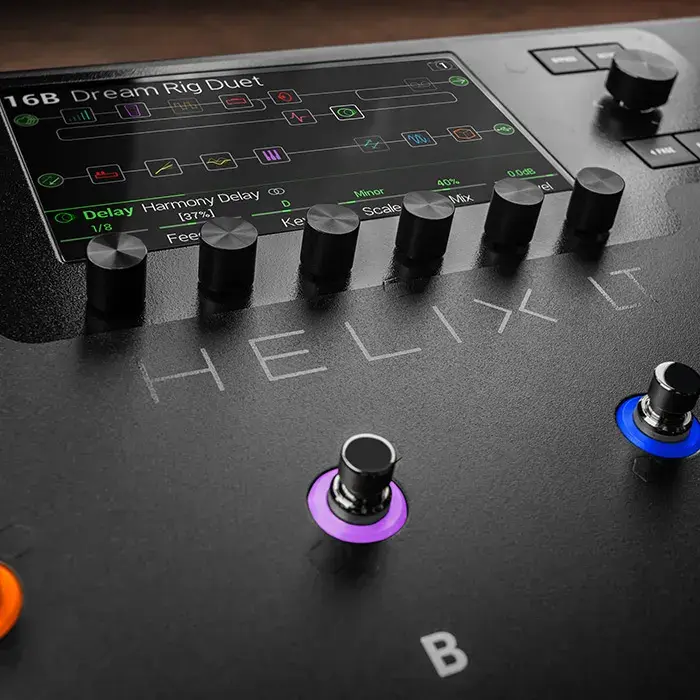
Both processors have 12 capacitive, touch-sensitive footswitches with colored LED rings, but they do not present those switches in quite the same way. The switches handle duties such as mode and bank navigation, depending on the selected layout.
Floor places LCD scribble strips above its main switches and has 13 strips in total, including the expression-pedal status strip. They show the current assignment, accept custom labels and can warn you when several items share one switch. If a set moves between amps, effects and snapshots every few bars, those individual labels can prevent the familiar moment when every glowing ring suddenly looks like the wrong one.
LT has no scribble strips, but it is not working blind. Its Performance View places colored switch labels together on the main 6.2-inch display, which has the same 800-by-480 resolution as Floor’s screen. Both models also let you touch a switch to select its assigned block for editing, hold it to make assignments and swap assignments between switches.
Do you need the scribble strips? Players who use snapshots for most song changes may be perfectly happy with LT’s central display, while a complicated stomp-based set benefits more from Floor’s labels. This is a workflow difference rather than a tone feature, but on a dark stage that workflow can be worth more than another unused effects loop.
Also check
Inputs and outputs are what the extra money buys
Helix LT already covers the connections needed by many guitar rigs. It has Guitar In, two sends and two returns, stereo XLR and quarter-inch outputs, headphones, Variax, MIDI In and Out/Thru, USB and a shared AES/EBU/L6 LINK connector. Its loops can operate as mono connections or be paired for stereo pedals.
Floor adds an XLR microphone input with switchable 48-volt phantom power and a variable low-cut filter, plus an Aux input for another instrument. It doubles the sends and returns from two of each to four of each, and it adds coaxial S/PDIF input and output. S/PDIF and AES/EBU cannot operate at the same time, so this is extra choice rather than two simultaneous digital systems.
Expression and control connections also differ. LT has one EXP PEDAL 2/EXT AMP socket that must be set globally to one role or the other. Floor separates EXT AMP 1/2 from its EXP 2 and EXP 3 inputs, then adds a CV/Expression output for controlling suitable pedals or synthesizers.
Both units include an onboard expression pedal with a hidden toe switch for moving between EXP 1 and EXP 2 behavior. Floor gives headphones their own level control, while LT’s main Volume knob also controls the headphone level. Floor is therefore easier when the main outputs must stay at one level while you adjust monitoring.
Both models work as multi-input/output USB 2.0 audio interfaces at up to 24-bit/96kHz, with DI recording, re-amping and MIDI support. Their core USB recording job is the same, although Floor’s mic preamp, Aux input, digital S/PDIF and separate headphone knob make a more flexible studio front end. Windows needs the Helix ASIO driver, while the additional Mac Core Audio driver is needed only for USB rates other than 48kHz.
Which Helix fits your rig?

The right model becomes clearer when you map the connections your rig uses rather than counting every socket on the back panel. LT reaches surprisingly far because it retains balanced outputs, two loops, MIDI, Variax, USB and amp control. Floor pulls ahead once several outside devices need independent routes or control at the same time.
Guitar straight to a PA or FRFR speaker
LT covers this rig with its Guitar In, balanced XLR outputs, onboard expression pedal and full HX processing. It can send stereo or mono sound to the PA while its snapshots handle changes inside a preset. Floor sounds no better here unless its scribble strips make your live switching safer.
An amplifier using the four-cable method
The four-cable method needs one send and one return, so LT can handle it without using all its loops. Its shared EXP PEDAL 2/EXT AMP jack can switch a traditional amplifier when configured for that job. Choose Floor if you also need extra expression control without giving up the separate amp-control connection.
Several external pedals in different positions
LT can place two mono loops, or one paired stereo loop, at chosen points in a preset. Floor’s four sends and returns suit a board where several pedals need separate switching or different positions around the amp and cab blocks. A pedal drawer that keeps breeding is one of the few studio problems Floor is ready to encourage.
Guitar and vocals or a second instrument
Floor is the clear choice when the processor must accept a vocal microphone directly. Its mic input provides phantom power and a low-cut filter, while the Aux input accepts another active-pickup instrument. LT needs an outside preamp or mixer because it has neither input.
Recording and re-amping over USB
Both models can record a processed signal and a clean DI for later re-amping through USB. LT is enough when your microphone and other sources already enter through a separate audio interface. Floor becomes more useful when you want its microphone input, S/PDIF connection and independent headphone control to take on more of the studio work.
Price, firmware and preset support
At the checked Thomann prices, LT costs about 27 percent less than Floor while preserving the shared HX engine. Before paying the extra €300, count the connections you need now rather than the ones a future mega-board might use. If LT would force you to add a mic preamp, more loops or outside control hardware, part of that saving disappears.
Both units currently use firmware 3.80.0, released on November 19, 2024. Version 3.80 added six amp channels, four cabinets and the Teardrop Bass Q effect to the common Helix/HX library.
Line 6 currently tells users to update through HX Edit 3.82, which backs up the hardware before installing the firmware. A unit starting on firmware 3.15 or earlier may temporarily show “Boot Failure. Entered Update Mode!” during the process; Line 6 says to choose Resume in HX Edit. Restoring a complete old backup replaces the new factory setlist, so export any 3.80 factory presets you want to keep before restoring everything.
Helix LT and Floor share the same preset system and can exchange compatible Helix presets. That means our AURA and Reflections Helix bundle works with either model, subject to the pack’s listed firmware requirements. If the terms patches, tones and presets are getting mixed together, our explanation of what guitar presets are clears up the names.
Line 6 demonstrates the amps, cabinets and bass wah added to the shared Helix/HX platform in firmware 3.80.
Where Helix Stadium fits in 2026
Helix Stadium is a newer Line 6 generation, not a Helix Floor with a few more sockets. It introduces Agoura modeling, Proxy cloning, Showcase playback and automation, an eight-inch touchscreen, removable 32GB microSD storage and Nexus expansion. Its development also follows a separate firmware branch, which reached hardware version 1.4.2 on October 27, 2026.
The regular Line 6 Helix Stadium Floor costs €1,626 at Thomann, placing it €528 above the original Floor and €828 above LT at the checked prices. It has two effects loops, two external expression inputs, two amp-control outputs and two drum-trigger inputs, but it does not include an onboard expression pedal or the 12 OLED scribble strips found on Stadium XL. That makes standard Stadium Floor a different compact design rather than a direct replacement for LT.
Firmware 1.4 added 14 Agoura amp channels arranged within three models, six effects, USB editing, Showcase stem separation and faster preset loading. These are Stadium features and should not be confused with the original Helix line’s 3.80 firmware. Our Helix Floor, Stadium and Quad Cortex comparison looks more closely at the new generation beside other full-size processors.
Stadium can import individual presets, setlists, Favorites and IR files exported from Helix firmware or software 3.50 and later, but it cannot import a complete Helix backup. Imported .hlx presets become Stadium .hsp files and cannot be sent back to LT or Floor in that form. Older Hybrid cabs may sound different after replacement, and imported IR blocks need their IR files selected manually, so migration is useful but not perfectly reversible.
Which one should you buy?
Most guitarists should buy Helix LT. It provides the complete mature HX sound system, the same DSP, deep routing, snapshots, onboard expression, two loops and useful studio connections for €300 less at the checked prices. A guitar going into an amp, PA, FRFR speaker or existing recording interface rarely exposes LT’s missing sockets.
Buy Helix Floor when you know why you need it. Its scribble strips help with busy live sets, while its microphone preamp, Aux input, four loops, separate expression and amp-control sockets, CV output and dedicated headphone knob support larger rigs. Those are worthwhile professional tools, but none adds more HX processing or improves an amp model.
Choose Stadium when you want Line 6’s current generation, including Agoura, Proxy, Showcase and the touchscreen, and accept the higher price and different hardware layout. Our broader Line 6 modeler comparison covers the rest of the range. LT and Floor owners who want ready-made delay, reverb and high-gain sounds can also browse our paid Helix preset bundle.
Give Your Helix New Sounds
Our Helix bundle brings together ready-made delay, reverb and high-gain presets for both Helix LT and Floor. It is a practical way to expand either model without rebuilding every rig from an empty preset.
More information
Frequently Asked Questions
Does the Helix LT sound as good as the Helix Floor?
Yes. Helix LT and Helix Floor use the same dual-SHARC HX Modeling platform and current model library. Match the preset, input settings and output levels, and Floor has no extra HX sound or DSP advantage.
Do Helix LT and Helix Floor have the same processing power?
Yes. Both use the same dual-SHARC processing and dynamic DSP system. A preset does not receive more available DSP when moved from LT to Floor.
What does Helix LT lose compared with Helix Floor?
LT loses the scribble strips, mic and Aux inputs, two effects loops, S/PDIF, EXP 3, CV output and separate headphone control. Its external expression and amp-switching functions also share one jack, while Floor separates them.
How many programmable footswitches do Helix LT and Floor have?
Both have 12 physical capacitive footswitches, but the full stomp layouts differ. Helix LT shows assignments on its main display, while Floor labels its primary footswitch functions with individual scribble strips.
Can Helix LT use the same presets as Helix Floor?
Yes. LT and Floor share the original Helix preset architecture, so compatible presets can move between them. Keep both units and HX Edit current, and check any third-party pack’s firmware requirements.
Can Helix LT handle the four-cable method and external pedals?
Yes. A standard four-cable-method setup needs one send and return, while LT supplies two of each. Floor is more suitable when several external pedals require separately placed loops.
Are Helix LT and Floor still worth buying after Helix Stadium?
Yes, when you want the mature HX library and do not need Stadium’s Agoura models, Proxy cloning, Showcase or touchscreen. Stadium is a newer and more expensive generation, while regular Stadium Floor also lacks an onboard expression pedal.
Will Helix LT and Floor receive more firmware updates?
The latest available version for both models is 3.80.0. Stadium follows its separate 1.4.x firmware branch.
FOLLOW US ON


Comments