Korg Minilogue vs Minilogue XD: Which One Should You Buy in 2026?

Sep 7
11 min read
Updated: Sep 8
Korg Minilogue vs Minilogue XD is still a relevant comparison in 2026 because both synths share the same basic idea, but they now appeal to slightly different users. Both have 37 slim keys, four voices of analog polyphony, two analog VCOs and a 16-step sequencer, while the XD expands the original design with the Multi Engine from the earlier Prologue, stereo effects, user oscillators and effects, CV inputs, a joystick and much more preset memory.

Note: This post contains affiliate links. If you choose to buy through them, I’ll get a small kickback - at no extra cost to you. It helps me keep Noise Harmony going. Thank you! :)
The original Minilogue is still more than simply an older and cheaper version of the XD. Its switchable 2-pole/4-pole filter, eight voice modes, audio input and assignable slider are features the XD does not reproduce in exactly the same way, so there are still reasons to prefer the original depending on how you want to use the synth.
There is also a practical difference in availability. The Minilogue XD is still sold new in 2026, while the original Minilogue is now much more commonly found on the used market.

For most new buyers, we would choose the Minilogue XD. The Multi Engine, much better effects section and larger preset system make it more flexible without removing the simple hands-on workflow that made the original Minilogue popular.
Korg Minilogue vs Minilogue XD: quick comparison
The basic analog architecture is similar
Both synths use two analog VCOs per voice with saw, triangle and square waveforms, plus oscillator sync, ring modulation and cross modulation. Both also have four voices of polyphony, which is enough for basses, leads, arpeggios and four-note chords but can become restrictive when playing larger chords or patches with long release times.

The XD keeps this analog foundation and adds the Multi Engine as another sound source alongside the two VCOs, allowing analog oscillators and digital material to be combined inside the same patch. This is one of the main reasons the XD covers a much wider range of sounds without losing the basic Minilogue workflow.
The Multi Engine is the biggest reason to choose the XD
The Multi Engine comes from the earlier Korg Prologue architecture and is probably the most important addition in the XD. It includes Noise, VPM and User modes, with the VPM section providing 16 oscillator types for digital and FM-style sounds that can be layered with the two analog VCOs.
User mode supports oscillators created with Korg's logue SDK. The XD provides 16 user oscillator slots, with Korg's own Waves morphing wavetable oscillator included in the factory content. Users can manage or replace these slots through the Minilogue XD Sound Librarian, so the available content is not limited to what originally shipped with the synth.
This system has helped keep the XD relevant years after release because developers can create oscillators that were never part of the original hardware design. Depending on what you install, the Multi Engine can add different digital waveforms, more unusual synthesis methods and other sound sources that sit alongside the analog oscillators.

For us, this is the main reason the XD remains more interesting as a sound-design instrument. The original Minilogue gives you a very good analog architecture, but the XD lets you start with the same basic idea and then move much further away from traditional subtractive synthesis.
The filters are genuinely different
The original Minilogue has a resonant low-pass filter that can switch between 2-pole and 4-pole operation, which means approximately 12 dB per octave or 24 dB per octave. The 4-pole setting gives you a steeper cutoff and is useful when you want stronger removal of frequencies above the cutoff point.
The XD uses a different 2-pole low-pass filter with a Drive stage and follows the filter architecture introduced earlier in the Prologue. Both synths can use keyboard velocity to influence the filter envelope, so the real difference is the original Minilogue's switchable 12/24 dB design versus the XD's fixed 12 dB filter with Drive.
Neither approach is automatically better. The original gives you the steeper 4-pole option, while the XD gives you the additional drive stage and a different filter character.
Eight voice modes vs four main modes
The original Minilogue has eight voice modes: Poly, Duo, Unison, Mono, Chord, Delay, Arp and Side Chain. These modes change how its four analog voices are assigned and can produce some unusual results, particularly with Delay and Side Chain.

The XD has four main Voice Modes: Poly, Unison, Chord and Arp/Latch, but that does not mean all of the original voice-allocation ideas disappeared. In POLY mode, the Voice Mode Depth control can move toward a DUO-style behavior, while CHORD mode can also cover mono and chord-type settings. The main functions that are genuinely missing as dedicated Voice Modes are Delay and Side Chain.
It is also worth noting that Latch is not an exclusive XD feature in 2026 because Korg added latch behavior to the original Minilogue's arpeggiator through firmware version 1.21. The original still offers more dedicated Voice Mode options overall, while the XD puts more emphasis on its expanded oscillator, effects and sequencing systems.
Slider vs joystick
One difference you notice immediately when playing the two synths is the performance controller. The original Minilogue uses an assignable slider, which can be linked to different parameters and is useful for changing one part of a patch while playing.
The XD replaces this with a joystick that handles pitch bend horizontally and modulation vertically. The Y-axis directions can be assigned to parameters, which gives you more performance control from a single controller and makes the layout more familiar to players coming from larger synthesizers.
This does not necessarily make the original slider worse, because some users prefer the simplicity of one assignable control, but the joystick is generally more flexible for expressive playing.
Effects are much more advanced on the XD
The original Minilogue has a built-in delay with high-pass filtering, feedback and pre/post-filter routing. It is useful and has a distinctive character, but it is still a relatively simple effects section.
The XD adds three effect categories: modulation, delay and reverb, and they can be used together. The factory effects include chorus, ensemble, phaser and flanger-style modulation alongside several delay and reverb algorithms, which means patches can sound much more finished without external pedals or plugins.

The XD also supports custom effects created through the logue SDK. Korg provides dedicated user locations for custom modulation, delay and reverb processors, so the effects section can be expanded in the same way as the oscillator section. This is a major advantage for sound design because both the sound source and the processing can be extended after purchase.
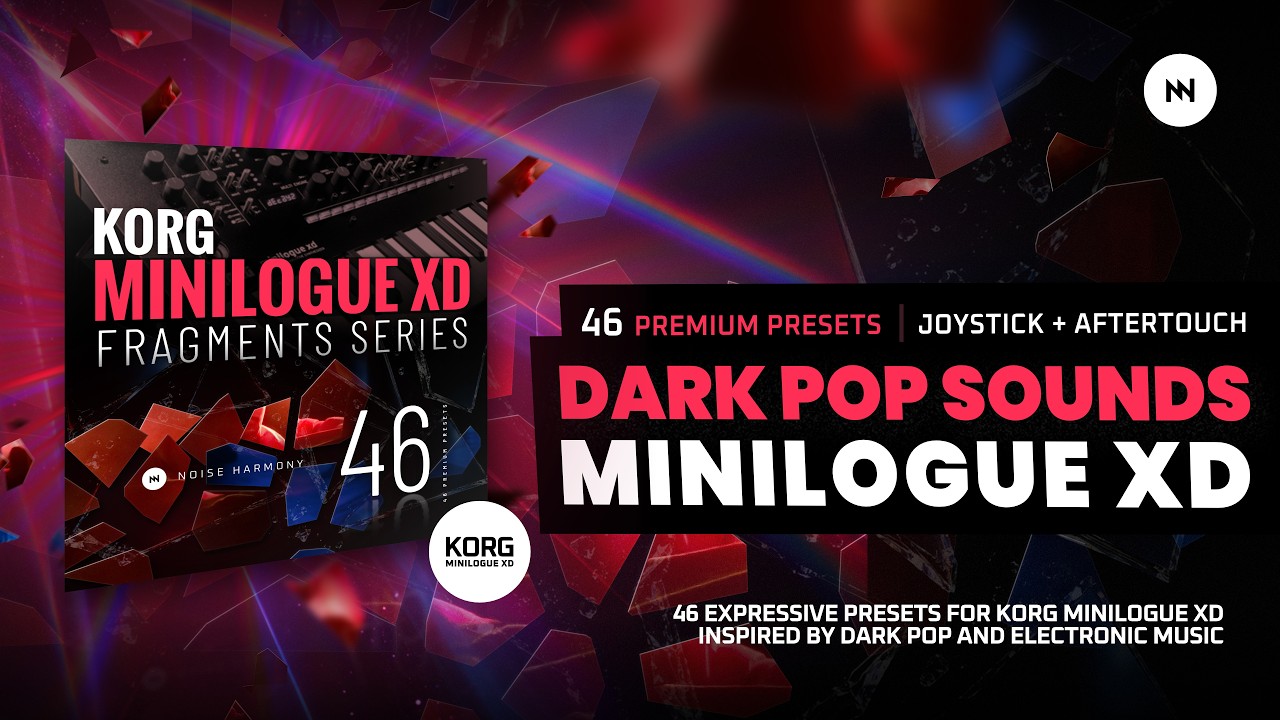
If you want to hear what the XD can do beyond its factory programs, we also have 15 free Minilogue XD presets available on Noise Harmony.
Sequencer and motion sequencing
Both synths have a 16-step polyphonic sequencer and can record motion for up to four parameters, so the sequencer can control both notes and knob movements. This makes it useful for short musical patterns but also for rhythmic sound design, where filter cutoff, oscillator shape or other parameters can change automatically across the sequence.
The XD received additional sequencer features through firmware updates, including Active Step and improved control over arpeggiator speed and gate time. Neither sequencer replaces a DAW, but both are fast for building short patterns directly on the instrument.
Our guide to Minilogue XD shortcuts covers several controls that are easy to miss when first using the XD.
Microtuning is available on both in 2026
Microtuning was one of the features promoted with the Minilogue XD and came from ideas already used in the monologue, allowing users to work with tuning systems beyond standard equal temperament. At launch this was a meaningful difference from the original Minilogue.
That changed with firmware updates because Korg added microtuning support to the original Minilogue in system version 2.00. In 2026, microtuning is therefore available on both instruments rather than being an XD-only feature.
This is a good example of why current firmware matters when comparing older hardware. Some differences that were important at launch no longer exist today.
Preset memory is much larger on the XD
The original Minilogue has 200 program locations, with 100 factory presets and 100 user locations. The XD expands this to 500 program locations in the factory setup: 200 factory presets and 300 user locations.
That extra memory becomes important if you regularly create your own sounds or install third-party banks because the XD can hold a much larger working library without forcing you to constantly overwrite existing patches. We use the XD regularly as a sound-design platform at Noise Harmony, so the larger user memory is genuinely useful in daily work rather than just being a larger number on the specification sheet.
KORG Minilogue XD | 130+ Presets | Motions & Isenveil [BUNDLE]
€41.98€27.29
Buy Now
If you want to expand the factory library, our Minilogue XD preset packs include custom sounds designed specifically for the XD, while the Motions & Isenveil Bundle combines more than 130 presets in one package.
Connectivity: both have Sync, but the XD adds CV and stereo
Both instruments include MIDI In/Out, USB MIDI and Korg's Sync In and Sync Out connections, so either can be synchronized with other compatible hardware.
The original Minilogue also has an audio input, which the XD removes. This lets the original accept an external signal for use in its signal path and remains a real reason to prefer it in some setups.
The XD instead adds stereo left and right outputs, two CV inputs and a damper pedal connection. Stereo outputs are particularly useful because the expanded effects section can produce stereo processing, while the CV inputs make integration with modular and semi-modular equipment easier.
The choice is therefore not simply that the XD has more connections. The original has Audio In, while the XD trades that feature for stereo output, CV control and damper support.
Poly Chain can increase XD polyphony
Both instruments are four-voice synths, and that remains one of their biggest limitations in 2026. A four-note chord already uses every available voice, so patches with long release times can produce voice stealing and larger keyboard chords are not possible in normal poly mode.
The XD does have a Poly Chain function that was added through the version 1.10 system update. Compatible Minilogue XD units can be chained together, including keyboard and module versions, to create an eight-voice setup.
That is useful if you already own two units, but it is not a particularly economical solution if you are buying a second XD only to gain more polyphony. If you know from the start that you need six or eight voices, another synthesizer may make more sense.
The keyboard and aftertouch
Both keyboard models use 37 slim velocity-sensitive keys, and neither built-in keyboard generates aftertouch. Players used to full-size keys may need time to adjust, although the smaller format is one reason both synths remain relatively compact.
The XD synth engine can, however, respond to MIDI aftertouch from an external controller after the firmware 2.00 update, so aftertouch can still be used as a performance source if your controller supports it. The XD is also available as a desktop module, which makes sense if you already own a full-size MIDI controller and do not need the built-in keyboard.
Prices and availability in 2026
The buying decision is also affected by the fact that these two synths now occupy different parts of the market. The Minilogue XD is still available new, with the keyboard version typically selling for around €550–€600 in Europe, while the desktop module is usually priced slightly lower.
The original Minilogue is now much more commonly bought used. Typical second-hand prices are broadly around €300–€400, while used Minilogue XD units usually sit higher, often around €350–€500 depending on condition, accessories and local availability.
That price gap matters. If you find a clean original Minilogue for around €300–€350, it can be a very good deal and becomes much easier to recommend. If a used XD is only around €50–€150 more, however, the Multi Engine, better effects, larger preset memory and extra connectivity usually make the XD the better long-term buy.
Which one is better for beginners?
Both are good instruments for learning synthesis because most important controls are directly accessible from the front panel, but the original Minilogue is the simpler teaching tool. Its two analog oscillators, filter, envelopes, LFO and delay give you a very clear subtractive synthesis architecture without introducing the extra digital oscillator system and expandable effects.
The XD is slightly more complex but gives you much more room to grow. A beginner can initially ignore the Multi Engine and use the synth almost like a traditional two-VCO analog instrument, then start exploring VPM, user oscillators, custom effects and deeper sequencing later.
We have used the XD for years and still consider it a strong synth for learning sound design, which is why it also appears in our guide to the best synthesizers for beginners in 2026. We also have a separate guide on whether the Minilogue XD is good for beginners.
If both models are available at similar prices, we would normally recommend the XD because you can learn the same basic analog concepts while having more options available later.
Which one sounds better?
There is no single answer because the analog sections are not identical. The original Minilogue has the switchable 12/24 dB per octave filter and additional Voice Modes, while the XD uses its own 12 dB per octave filter with Drive and adds the digital Multi Engine.

For a simple two-oscillator analog patch, personal preference for the filters can matter more than the longer XD specification sheet. The original can sound excellent and should not be treated as a worse-sounding version of the XD.
The XD wins when you look at the total range of sounds it can produce. Digital VPM, user oscillators and a much larger effect system allow it to create patches the original cannot reproduce by itself, while still retaining two analog VCOs as the foundation.
Our take: we would choose the Minilogue XD
At Noise Harmony, we would choose the Minilogue XD. It has been part of our sound-design setup for years, so our preference comes from actually building presets on the instrument rather than only comparing specifications.
The Multi Engine is the main reason. Two analog VCOs already cover traditional analog sounds, while the digital oscillator can add VPM, custom waveforms and third-party user oscillators without requiring another synth. The expanded stereo effects are equally useful because a patch can be taken much further before any external processing is needed.
KORG Minilogue XD | 130+ Presets | Motions & Isenveil [BUNDLE]
€41.98€27.29
Buy Now
The larger program memory, user oscillator and effect system, joystick, stereo outputs and CV inputs also make the XD better suited to the way we work. We also create Minilogue XD preset packs, so we spend a lot of time working with the instrument beyond its factory sounds.
At the same time, the original Minilogue still has features we genuinely miss on the XD, particularly its 4-pole filter option, additional Voice Mode possibilities and Audio In. We therefore see the XD as the more flexible instrument overall rather than simply a replacement that improves every part of the original.
Which one should you buy?
If you want a simple analog polysynth and can find the original Minilogue at a significantly lower used price, it remains a very good choice. Its two VCOs, switchable 12/24 dB filter, broader set of Voice Mode behaviors, sequencer and direct interface give you plenty of sound-design options without adding a second digital synthesis layer.
If prices are reasonably close, we would choose the Minilogue XD. The Multi Engine, user oscillators, much better effect system, 300 user program locations, stereo outputs, CV inputs and joystick give it more room to grow while keeping the basic analog workflow easy to understand.
The original is therefore still worth buying when the used price is right, but for most new buyers in 2026, the Korg Minilogue XD is the stronger long-term choice.






Comments