Line 6 Modeler Comparison: Which One Should You Actually Buy?
- Noise Harmony
- 5 hours ago
- 15 min read

You've decided your next guitar processor is going to be a Line 6. Good call. Now you're staring at a lineup that runs from a €165 POD Express to a €2,338 Helix Stadium XL Floor, and one question is keeping you up at night: does the expensive one actually sound that much better? This Line 6 modeler comparison gives you the honest answer, and it might save you a pile of money. Tone-wise, not one of these boxes will let you down. Every single one can get you a great sound for recording, for band practice, and out at a gig. Where they split apart is processing power, connections, workflow, and how many jobs you want one box to handle at once.
Note: This post contains affiliate links. If you choose to buy through them, I'll get a small kickback, at no extra cost to you. It helps me keep Noise Harmony going. Thank you!

I've put real hours into a good chunk of this family: the Helix Stadium XL Floor, the Helix LT, the POD Go, the HX Stomp, and the HX Effects. So most of what follows comes from actually using them, not from reading a spec sheet. Let me walk you through the range and help you land on the one that fits your setup.
Table of contents
They all run the same engine, mostly
Here is the part nobody tells you up front. The reason a budget POD Go and a flagship Helix Floor can sound shockingly close on a simple patch is that they share the same brain. Line 6 calls it HX Modeling. The amps and effects are built from the same models right across the range, so a clean Fender-ish sparkle or a tight metal rhythm tone is leaning on the same underlying math whether you spent €466 or €1,199.
So what are you paying extra for? DSP. That stands for digital signal processing, and it is basically the horsepower inside the box. Every amp, cab, and effect you drop into your signal chain eats a slice of it. Each of those items is called a block. Run out of DSP and the unit just won't let you add another block. The bigger units carry more of it, so you can build deeper, more layered rigs and stack two amps with multiple effects on each side. The smaller ones force you to make choices.
The Helix Stadium bends this rule a little. It runs a newer modeling engine that Line 6 named Agoura, and the Stadium models in a noticeably more detailed, more responsive way than the older Helix, with extra power sitting on top. We'll get to what that feels like in a second. The takeaway for now: pick your box around how much rig you need to build and how many roles it has to play, because the raw tone quality is a given. If you want to hear the engine that powers the whole family inside your DAW (except new Helix Stadium Agoura amps), we wrote a full explainer on Helix Native.
Helix Stadium Floor and XL: the do-everything command center
The Helix Stadium is the newest and most ambitious thing Line 6 has built, and I'll say it plainly: it sounds different from the older Helix. To my ears, better. The new Agoura amps are the headline, and you can genuinely hear the jump in quality and how the amp responds to your pick attack.
One honest caveat, because a review that loves everything tells you nothing. Sit the Stadium next to a Fractal and you can still catch a sliver of that digital sheen in the tone, a tiny bit of plastic that you have to dial out with some work. It's not a dealbreaker, and most of the time you won't notice it in a band mix, but it's there if you go looking.
What makes the Stadium special is everything around the tone. There's an 8-inch touchscreen, so building and tweaking feels like using a phone instead of clicking through menus. Focus View lets you audition different amps and effects fast, which is a gift when you're hunting for a sound and don't want to lose momentum. My favourite new feature is the Showcase automation engine. You can practice along to backing tracks straight off the unit with no laptop in sight, and on stage it can automate your whole set, even drive your lights. The Stadium can run several instruments at once, or cover a singing guitarist who's also triggering backing tracks, all from one box. That turns a single unit into the command center for your whole gig.
There's one more bit of honesty owed here, and this time it's about software rather than sound. The Stadium is brand new, and some owners are running into bugs, we're on firmware 1.3.2 as I write this, though Line 6 has been pretty quick to patch them as they surface. I've hit a few minor ones myself, nothing close to a dealbreaker. The two that nag me most right now are that you still can't edit presets over USB, and the odd volume jump when you switch snapshots. Worth keeping in perspective, though: this is new hardware still going through its final polish, and that's exactly the stage where these things get ironed out.
Also check:

The two versions split on size and connections, not sound. The Stadium XL Floor (€2,338) gives you a built-in expression pedal (the rocker pedal you use for wah or volume), scribble strips (the little per-footswitch labels), two instrument inputs, and four effects loops for routing external pedals. The Stadium Floor (€1,830) keeps the exact same Agoura engine, the same DSP, and the same touchscreen, but drops to one input, two effects loops, and no built-in expression pedal, with footswitch labels living on the touchscreen instead. If you play big, complex shows or run a wet-dry-wet rig, the XL earns its keep. For most players, the standard Stadium Floor is the smarter buy.
Here's the thing, though: the Stadium is the deepest and priciest box in this whole comparison, and it's the one people are least sure about before they buy. If you're on the fence about whether all that power is actually for you, we put together a 10-episode beginner guide to the Helix Stadium that walks you through it from the ground up, so you can see exactly what it does and what living with one feels like day to day. Watch that before you commit. It's the fastest way to find out whether the Stadium is your box, or whether something further down this list fits you better.
We covered the launch in depth in our Helix Stadium announcement and broke down the new tools in how to actually use the Stadium's features. We also build dedicated Helix Stadium reverb presets voiced around those new Agoura amps.
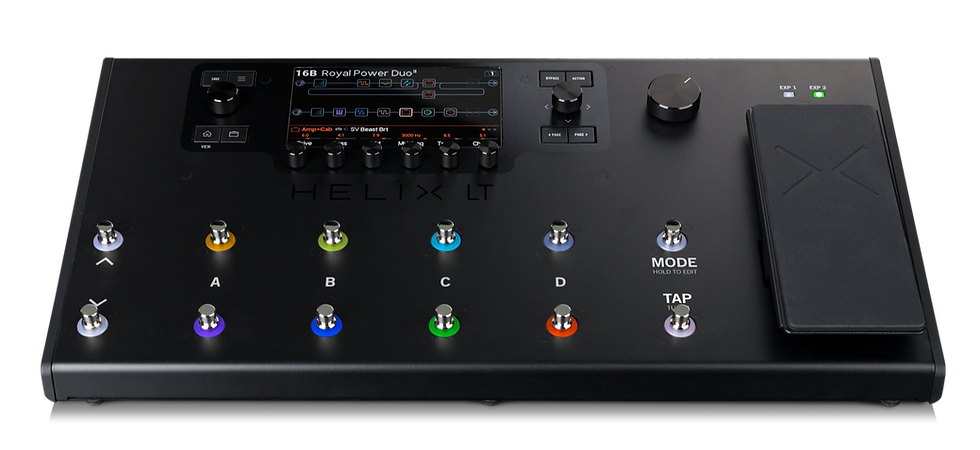
Helix Floor, Rack and LT: the classic full rig, now cheaper than ever
Before the Stadium arrived, this was the top of the tree, and it's still a monster. The classic Helix gives you up to 32 blocks across four stereo signal paths, which in plain terms means you can build enormous rigs: two amps running in parallel, each with its own cab and a long chain of effects, stereo all the way out. It has the DSP to back that up. There's no touchscreen and no Showcase-style gig automation here, so this is the box for the player who just wants to plug in, shape tone with a lot of freedom, and not pay for stage-management features they'll never touch.
I've used Helix LT for a long time, and it still pulls fantastic sounds. Getting around it is a little less intuitive than the Stadium's touchscreen, but once it's under your fingers it's quick. The three classic units share the same engine and tone, and differ mostly in format and I/O.

The Helix Floor (€1,199) is the full-fat original: every connection you could want, color scribble strips, a built-in expression pedal, and the most footswitches of the three. The Helix Rack (€1,299) takes that same engine and bolts it into a rack unit, which suits a studio or a fly rig you control with MIDI or the separate Helix Control footboard. The Helix LT (€849) is the value pick of the family. It runs the same dual-DSP power as the Floor, so you get the identical 32 blocks and four paths, but Line 6 trimmed the I/O and the color scribble strips to hit a lower price. For a player who wants the full Helix tone engine without the studio-grade connectivity, the LT is one of the best deals in modeling, especially now it sits at €849.

These prices are worth a pause. With the Stadium now on top, the classic Helix line has quietly become a bargain. A Helix LT at €849 does almost everything most guitarists will ever ask of a modeler. If you want sounds ready to load onto any of them, our roundup of the best Line 6 presets is a good place to start.
HX Stomp and HX Stomp XL: same tone, fraction of the size
This is where a lot of players should be looking, and it's the part that surprises people. The HX Stomp runs the same engine and the same models as the Helix Floor, Rack, and LT. The amps and effects sound identical. You are not getting a watered-down tone by going small. What you give up is room: the HX Stomp tops out at 8 blocks instead of 32. So if you dream of two parallel amps with a full chain on each path, you'll run out of space. For the far more common setup, one amp and four or five effects, 8 blocks is plenty.

The standard HX Stomp (€629) has just three footswitches, which gets tight live once you want a few sounds plus a tuner and a tap tempo. The HX Stomp XL (€679) keeps the same engine and the same 8 blocks but adds an additional row of footswitches (so you get 8 in total) and one extra snapshot per preset, which makes it far more versatile. Neither has a built-in expression pedal, though both let you add one (or a pair of external footswitches) if you need wah or volume swells. For €50 more, the XL's extra switches are an easy yes for most gigging players, unless pedalboard space is genuinely tight.
We broke the two down in detail in what the HX Stomp and HX Stomp XL are and how they differ. And because the Stomp shares the Helix engine, our HX Stomp delay and reverb presets load straight onto it.

POD Go and POD Go Wireless: budget all-in-one with a ceiling
The POD Go is the affordable way into the family, and it's a genuinely good little unit, but this is the one place where you can actually hear the compromise. It comes with eight footswitches and a built-in expression pedal in the box, so out of the gate it's more gig-ready than an HX Stomp, and at €466 it's easy on the wallet. The catch is DSP. The POD Go has far less of it than a Helix, and several blocks in its signal chain are fixed in place, so your room to build is limited.

I used a POD Go for a while and kept bumping into the same wall: I was always sacrificing something. You don't get dynamic effects in stereo, for example, and there's just less power to throw around than I wanted. It does every individual job well, but you feel the ceiling the moment you ask for a lot at once. The POD Go Wireless (€555) is the same unit with a built-in receiver for a Line 6 Relay wireless system, so you can go cable-free without strapping a separate receiver to your board. The plain POD Go (€466) is the one to get if you don't need wireless.
So who is the POD Go for? The player with focused tone needs who wants a compact, affordable all-in-one with an expression pedal built in, who doesn't need to go crazy with effects. If that's you, it's a smart pick. We have a full POD Go explainer if you want the deep dive, plus dedicated POD Go reverb presets and POD Go delay presets built to get the most out of its DSP.
HX Effects, HX One and POD Express: the specialists
These three aren't really full modelers, and you shouldn't shop for them like they are. Each one solves a specific problem. I've spent time with the HX Effects, but not the HX One or the POD Express, so for those last two I'm leaning on the specs and where they fit rather than a hands-on verdict.
The HX Effects (€555) is for the player who already loves their real amp but wants Helix-quality effects in front of it or in the loop. It carries the Helix effects engine with up to 9 effect blocks and six scribble strips, but it leaves out amp modeling on purpose. If you're a tube-amp loyalist who just wants world-class delays, reverbs, and modulation on a tidy board, this is your box. There's also a clever budget angle here that's caught on with a lot of players: pair the HX Effects with a cheaper amp modeler like IK Multimedia's ToneX, let the ToneX serve up the amp tones, and let the HX Effects handle the delays, reverbs and modulation. You end up with premium Line 6 effects and a solid amp sound for a bit less than a full Helix Floor. However, you might want to weigh it against a Helix LT depending on your needs and current deals. It will also work great with other instruments and vocals! If you decide to get one, check out our HX Effects delay and reverb presets.

The HX One (€249) is the smallest idea in the range and a clever one. It's a single-effect pedal that gives you access to over 250 Line 6 effects, one at a time, in a footprint that drops onto any pedalboard. Say you want one really good delay on your board and you can't decide which boutique pedal to buy. The HX One hands you a huge library of Line 6 delays, reverbs, and more in one slot, and those effects are seriously good. Think of it as a Swiss-army effect pedal.

The POD Express (€165 for guitar, €169 for bass) is the entry point, full stop. It's a knob-per-function box with seven amps, a set of cab models, a handful of effects, and a looper, controlled by turning dials rather than diving into menus. There are no deep presets, no advanced routing and no touchscreen, you just grab it and play. For a beginner who wants legit HX Modeling tone for practice or a first recording without spending much, it's the cheapest door into the Line 6 family.

The full comparison at a glance
Here's the whole range side by side. Sort it by price, by power, or by what you actually need the box to do. Prices are from Thomann and were current when this blog post went up.
A quick note on those numbers. The block and path counts are the clearest measure of how big a rig you can build, and they line up almost perfectly with price. The interesting outliers are the classic Helix units, which now undercut the Stadium by a wide margin while still giving you the full 32 blocks.
Check the I/O before you buy
One thing before you spend a penny: check the I/O on the back of the box. Tone is a given across this range, but the connections decide whether a unit really fits your setup. If you run straight into the PA, you want balanced XLR outputs, and only the Helix and Stadium models have them. Everything else sends out on 1/4" jacks and wants a DI box to feed a desk cleanly. Planning a four-cable rig with a real amp, or a few outboard pedals? Count the effects loops, because an HX Stomp gives you one and a Helix Floor gives you four. Watch the small stuff too. The POD Go does MIDI over USB only, and both the HX Effects and HX One skip a headphone out and can't record over USB. Two minutes matching the back panel to how you actually play saves you a return later.
Sort it by whatever matters to your rig. If you go straight to front of house, filter down to the units with XLR outs. If you lean on outboard pedals, the effects-loop column is the one to read first.
So which Line 6 modeler should you buy?
Let's make this concrete. If you record at home or in a bedroom setup and want the best tone for the money, the Helix LT at €849 is hard to beat, and an HX Stomp at €629 gets you the identical sound in a smaller box if you don't need a wall of footswitches. If you gig regularly and want one unit to run your whole show, backing tracks, automation, and all, the Helix Stadium Floor is the obvious target, with the XL there for the biggest, most complex rigs, however keep in mind that as of now (mid 2026) it still has some unresolved software issues. If you already have a real amp you love and only want top-tier effects, the HX Effects is built exactly for you, and the HX One covers it if you just need one great effect on your existing board. And if you're on the tightest budget or buying your first modeler, the POD Go gives you a gig-ready all-in-one, while the POD Express gets you real Line 6 tone for the price of a single boutique pedal.
If you're weighing an upgrade, the question is what's actually frustrating you. If you keep running out of room on an HX Stomp or hitting the POD Go's ceiling, step up to a classic Helix or the Stadium. If your current box does everything you ask and you just fancy a touchscreen, maybe your money is better spent elsewhere. This is the misconception worth mentioning: people assume the cheaper boxes sound worse, but they don't. On a POD Go you simply can't build a single do-everything preset that covers an entire varied set, whereas on a Stadium or a Helix Floor you can. That's a capability gap, not a tone gap.
One last thing from our side of the fence. We build guitar presets across most of these platforms, and a genuinely tricky part of the craft is translating a sound designed on a high-DSP box down onto something with less power so it still feels right. But I think that the fact that we were able to make them feel and sound good across the lineup proves that you can make any of these modelers sound good if you put in enough time and focus.
Frequently asked questions
Do all Line 6 modelers sound the same?
On a simple patch, surprisingly close, because the Helix, HX Stomp, HX Effects, and POD Go all run the same HX Modeling engine. The Helix Stadium is the exception, with its newer, more detailed Agoura engine. The real differences across this Line 6 modeler comparison are DSP power, connections, and workflow, not raw tone quality.
Is the Helix Stadium worth it over the regular Helix Floor?
It depends on what you need. The Stadium adds a touchscreen, the new Agoura amps, and the Showcase automation engine for backing tracks and live control. If you want a gig command center, it's worth the jump. If you only want to shape tone and play, the classic Helix Floor does that beautifully for around €600 less. Please keep in mind that as of now (mid 2026) Stadium still has some unresolved software issues.
What's the cheapest Line 6 modeler that can gig?
The POD Go at €466. It ships with eight footswitches and a built-in expression pedal, so it's stage-ready out of the box. The POD Express is cheaper at €165 but I would say that it's built more for practice and bedroom recording than for switching sounds with your feet mid-set.
HX Stomp vs POD Go, which should I buy?
Buy the HX Stomp if tone-shaping depth and the full Helix engine matter most, and you don't really need a lot of footswitches. Buy the POD Go if you want a gig-ready layout with an expression pedal built in for less money. The HX Stomp has more usable DSP, the POD Go has more controls in the box. Also, you can never go wrong with HX Stomp XL. You get additional footswitches and more processing power than POD Go and it's only €50 more than HX Stomp.
Can the POD Go do everything the Helix can?
No, and that's the honest limit. The POD Go has less DSP and several fixed blocks, so you can't build the huge, do-everything rigs a Helix or Stadium allows, and some effects won't run in stereo. For focused sounds it's great. For one preset that covers a whole varied set, you want a Helix.


Comments